Showing posts with label hollywood. Show all posts

Tuesday, April 3, 2012

The Hunger Games - Violence as Spectacle

As a fan of all things “saga,” of course, I read The Hunger Games trilogy by Suzanne Collins. Founded on the premise of a dystopian society set in the future, the series follows Katniss Everdeen who volunteers in the annual tournament that selects children from each area to fight to the death. These “games” are televised to remind all of the citizens of Panem what can happen when a nation embarks on civil war and the resulting chaos. Katniss, played by Jennifer Lawrence, who exudes both courage and desperation, steps in to fight in place of her little sister, Prim. The rest of the film follows her heroic quest to win the hunger games for the sake of her family.

The film by Gary Ross brings to life what Collins has put to page. Shot in North Carolina, District 12 appears as a war-torn depression era slum. The shaky camera employed by Ross gives the feeling of instability - districts on the edge of revolt. Children shuffle in a single file line towards the reaping (name drawing) eerily reminiscent of concentration camp lines.
Opposite we have the Capital, where the powerful and elite live and prosper from the work of the districts.  Every detail from Collins' book is accounted for at the Capital from the other-worldly makeup to the futuristic furniture and opulent food in the hotel. The establishing shot of the Capital is right out of Metropolis (Fritz Lang, 1927 - a film that also explores the divide between classes). The opening ceremonies take place in a monolithic Roman colosseum and the metaphor continues as tributes ride in on chariots; they are gladiators readying for battle.  

Clearly, the film centers on the theme of violence. Not only do children fight children, but districts fight against the power of the Capital. The most striking image of the film is the District 11 revolt after their tribute fighter, a young girl named Rue (Amandla Stenberg), dies. An image, not unlike photos from the 1960s race riots, erupts as the district people attack the peacekeepers who work to keep the districts in line. Water hoses are aimed into the indignant crowd, freshly angered with pain and grief after watching Rue die on screen.  Unfortunately, the quick paced camera movements do not linger long enough to capture the full impact of Rue’s death. Rather the story quickly moves back to the arena. The film is afraid to linger on an uncomfortable subject for too long. 
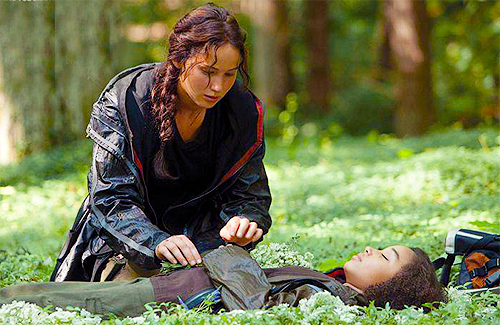
In the arena, fast paced editing and a non-diegetic soundtrack mitigate the violence of children fighting to the death. The first killing scene in the games takes place at the cornucopia and sets the stage for the treatment of violence among children. The camera glances the quick and swift kills. A symphonic score covers the sounds of what should be children crying out in pain, or perhaps for mercy. The final scene faces violence a bit more directly as the last three tributes fight atop a metallic structure that looks like a Frank Gehry design. Katniss’ final kill is one out of mercy as her opponent is attacked by genetically altered dogs. She saves Peeta, secures the win, and avoids murder when she can.

The lack of long takes and diegetic sounds allow us as viewers to enjoy the film and feel decent about watching children fight to the death. The lack of graphic images not only lets in the 13-year-old fan base, but also allows us to feel okay with what we’ve seen on screen. Initially drawn in by extreme close ups, we come to know the characters well and form a close connection with Katniss. This connection also allows us to watch the spectacle and take pleasure in it; we are suffering with Katniss and Peeta. The film could have taken a grittier look at violence as entertainment, thematically, but I’m sure opening weekend wouldn’t have been as big a success.

Thursday, October 27, 2011

The Ides of March


George Clooney has tried his hand at directing again with The Ides of March. Based on the 2008 play, Farragut North by Beau Willimon, the name was fittingly changed to reflect Ceasar’s days of betrayal as well as Shakespeare’s great work Julius Caesar. Clever Clooney puts many literary allusions to work. The plot, in short, focuses on a political race for the democratic seat where the real players are the men behind the scenes calling all the shots. On a larger scale, the film is a psychological drama set in a political arena that revolves around thematic ideals of loyalty and allegiance - but at what cost to individual honor? The opening scene shows Stephen, the young campaign manager played by Gosling, as he checks the stage and microphone for the Governor’s (Clooney) debate already suggesting that he is the puppet master. The film continues with the fight for the democratic seat, as the moral ambiguity of the central characters (played by Gosling, Clooney, Hoffman and Giamatti – all finely acted, we already know they are good at their craft) creates a thrilling power struggle until the end. It also makes us question who the good guy is and who the bad guy is as ideals and allegiances change.

The film contains realistic character studies of people in the political realm which will strike close to home with the upcoming elections in Washington. Aside from the political jargon that might float over your head, Clooney and his team did a great job with the script adaptation and dramatic dialogue. But the climax of the film that shifts the choice and path of the characters has holes. The intern, a title that already makes one think “sex scandal,” played by Evan Rachel Wood, lacks character development. Her eventual situation with the governor and tragic demise (however Ophelia-esque it might be, since Clooney is clearly thinking of Shakespeare) lacks credibility. We don’t know enough about her past to make her actions realistic, which unfortunately leads to plot holes, and takes away from the film at a pivotal moment.

The visuals and camera work border on corny, and Phedon Papamichael’s cinematography plays it safe. The camera lingers too long on Gosling silhouetted by the giant American flag that takes up the screen. In another emotional moment, he cries as the rain beats down on the windshield. The lack of subtlety leaves nothing to the imagination. However, I did like the close ups on intimate conversations. For example, the shot of Gosling and Wood flirting in the bar draws us in and suggests the secrecy of politics in general; the framing is suggestive and dangerous. The musical score creates a jarring turn that reflects the anger and revenge Gosling feels towards the Governor. But other musical moments, for example the random jazz song that gets too much camera time in the bar, seem out of place and without reason.

At the end of the film Gosling confronts Clooney in the shadowed kitchen of a closed restaurant – an almost mafia moment – where he proclaims “you don’t fuck the intern.” This political cloak and dagger again alludes to Shakespeare’s play and shifts the power back to Gosling. For him, the end will justify the means even if it calls for blackmail. The final shot is a slow zoom to an extreme close up on Goslings face, with his ear piece, as the face of the governor’s campaign. He now has all the power, but we are left to wonder what he will do with it.