Showing posts with label film review. Show all posts

Tuesday, May 29, 2012

To Kill a Mockingbird


Last week I ventured to {Poem88} Gallery in Atlanta’s West Side Arts District for the screening of Robert Mulligan’s classic To Kill a Mockingbird (1962). Robin Bernat curates the series “Films for the 99%,” citing it as an opportunity for the community to engage in films that focus on politics and protest. Mockingbird explores civil rights injustices central to Harper Lee’s novel, as well as economic and class segregation. Set in Alabama, this courtroom drama follows the arrest and imprisonment of Tom Robinson (Brock Peters), falsely accused of raping a white woman. The narrative revolves around attorney Atticus Finch (Gregory Peck) and his children, Jem and Scout, who are all deeply affected by the events of that summer. Mulligan presents two main story lines that eventually intersect: the court case of Tom Robinson and the mystery of Boo Radley (Robert Duvall), a rumored “monster” who strikes fear in the hearts of children. The real villain of the story is the ignorant racist Mr. Ewell, the man who falsely accuses Tom of raping his daughter. 

Robert Mulligan and Russell Harlan employ authoritative camera work and framing to allow children and African Americans a voice. The film begins with the voice over narration of Scout as an adult reminiscing about her childhood. Children play a central role to Mockingbird, and Mulligan gives them exclusive narrative authority. Deep focus shots highlight children in the foreground and adults in the background. The childrens’ faces are often times shot in close up, and the story is told through their point of view. The camera empowers the children and lends credibility to their story. 

The camera also empowers the African American characters central to the film. Almost every shot of Tom and his family is full or low angle signaling the respect and consideration that they deserve, but unfortunately, do not attain in the story. [Low angle shots serve to visually empower the character. For example, Atticus is  shot mostly in low angle.] The camera work in the film communicates the respect given to African Americans, which echos the camera's treatment of Atticus.

Mulligan book-ends the film with the image of a hand moving across the screen representing both real and imagined threats. The first hand belongs to Boo Radley’s shadow, reaching out to pet the children. The second hand is Mr. Ewell’s in an attempt to harm the children. The children imagine Boo to be a monster, but in the end he is their savior. Mr. Ewell is the real threat to the children and the town at large.The race and class injustices throughout Mockingbird make the film a necessary addition to Bernat's series, "Films for the 99%."

Tuesday, April 3, 2012

The Hunger Games - Violence as Spectacle

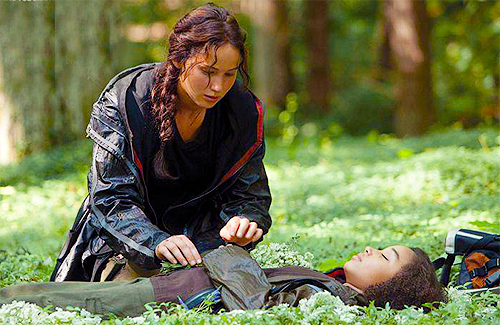
As a fan of all things “saga,” of course, I read The Hunger Games trilogy by Suzanne Collins. Founded on the premise of a dystopian society set in the future, the series follows Katniss Everdeen who volunteers in the annual tournament that selects children from each area to fight to the death. These “games” are televised to remind all of the citizens of Panem what can happen when a nation embarks on civil war and the resulting chaos. Katniss, played by Jennifer Lawrence, who exudes both courage and desperation, steps in to fight in place of her little sister, Prim. The rest of the film follows her heroic quest to win the hunger games for the sake of her family.

The film by Gary Ross brings to life what Collins has put to page. Shot in North Carolina, District 12 appears as a war-torn depression era slum. The shaky camera employed by Ross gives the feeling of instability - districts on the edge of revolt. Children shuffle in a single file line towards the reaping (name drawing) eerily reminiscent of concentration camp lines.
Opposite we have the Capital, where the powerful and elite live and prosper from the work of the districts.  Every detail from Collins' book is accounted for at the Capital from the other-worldly makeup to the futuristic furniture and opulent food in the hotel. The establishing shot of the Capital is right out of Metropolis (Fritz Lang, 1927 - a film that also explores the divide between classes). The opening ceremonies take place in a monolithic Roman colosseum and the metaphor continues as tributes ride in on chariots; they are gladiators readying for battle.  

Clearly, the film centers on the theme of violence. Not only do children fight children, but districts fight against the power of the Capital. The most striking image of the film is the District 11 revolt after their tribute fighter, a young girl named Rue (Amandla Stenberg), dies. An image, not unlike photos from the 1960s race riots, erupts as the district people attack the peacekeepers who work to keep the districts in line. Water hoses are aimed into the indignant crowd, freshly angered with pain and grief after watching Rue die on screen.  Unfortunately, the quick paced camera movements do not linger long enough to capture the full impact of Rue’s death. Rather the story quickly moves back to the arena. The film is afraid to linger on an uncomfortable subject for too long. 
In the arena, fast paced editing and a non-diegetic soundtrack mitigate the violence of children fighting to the death. The first killing scene in the games takes place at the cornucopia and sets the stage for the treatment of violence among children. The camera glances the quick and swift kills. A symphonic score covers the sounds of what should be children crying out in pain, or perhaps for mercy. The final scene faces violence a bit more directly as the last three tributes fight atop a metallic structure that looks like a Frank Gehry design. Katniss’ final kill is one out of mercy as her opponent is attacked by genetically altered dogs. She saves Peeta, secures the win, and avoids murder when she can.

The lack of long takes and diegetic sounds allow us as viewers to enjoy the film and feel decent about watching children fight to the death. The lack of graphic images not only lets in the 13-year-old fan base, but also allows us to feel okay with what we’ve seen on screen. Initially drawn in by extreme close ups, we come to know the characters well and form a close connection with Katniss. This connection also allows us to watch the spectacle and take pleasure in it; we are suffering with Katniss and Peeta. The film could have taken a grittier look at violence as entertainment, thematically, but I’m sure opening weekend wouldn’t have been as big a success.

Friday, January 13, 2012

My Week with Marilyn: Wait to Rent

Monroe in the 1957 film
Although Michelle Williams impeccably portrays the late, great Marilyn Monroe, there’s no need to rush to the theaters to see this one. It’s a light and mostly comical story about Marilyn Monroe shooting The Prince and the Showgirl in England in 1957. Based on the memoirs of Colin Clark (The Prince, the Showgirl and Me), the film is narrated by Colin (Edie Redmayne). He plays the third assistant on the movie set and imagines he can restore Monroe's self-confidence and dilute her profound sadness. If you look at stills from The Prince and the Showgirl, the resemblance of costumes and sets is uncanny; the film is markedly accurate in its portrayal. True to the tail, Laurence Olivier acts and directs the film. Kenneth Branagh is commanding as Olivier, seething at Monroe when she shows up late to set, but in love with the idea of her. 

The film opens with Monroe on stage, performing a musical number. As the camera pulls away, we see that it’s a cinemaplex with a large audience watching her on screen. In fact, Monroe doesn’t make an actual appearance in the film until the 20 minute mark when she debarks from the plane with the paparazzi’s bulbs flashing away. We are introduced to Monroe as an enigma, a star on stage always performing as “Ms. Monroe” for her public. She says sadly of her 3 failed marriages that people always want to be with "Marilyn" and when they find out its just her, they run. Monroe is a brand that sells well. The film also ends with Monroe on stage, performing again for her public.

I’ve seen a lot of Monroe films, and William’s portrayal of the actress is spot on with every affect. Her humor and lilting voice exude sex with every slow blink of her eyes. With excellent acting and a stellar soundtrack, it’s a nice film to rent at home but lacks the drama and force to pull you into the theater.

Monday, January 9, 2012

Melancholia

Denmark auteur Lars von Trier’s latest film, Melancholia, begins with a poetic overture filled with images that foreshadow what is to come at the end of the film.  The breathtaking mis-en-scene photographed by Manuel Claro captures an austere Victorian air starting with a lavish wedding and ending with the end of the world, literally. Von Trier takes us through the rapidly unraveling world of Justine who, it would seem, battles a crippling case of depression, although it’s not all together clear why she’s so upset. Played by Kristen Dunst, Justine is very good at faking happiness but soon spirals into palpable misery. Alexander Skarsgard plays the groom with only a few lines and departs half way through the film due Justine’s lack of faithfulness and faith in general. The rest of the story follows Justine and her sister’s family (sister adeptly played by Charlotte Gainsbourg) as they count down the days as the blue planet Melancholia plummets towards earth.

Von Trier’s creation starts with a visually stunning overture. The beginning opens with a slowly cranked montage of scenes set to Wagner’s operatic score Tristan and Isolde. Images of Justine laid out as Ophelia in her wedding dress floating in a river are paired with the perfectly laid out gardens of the family estate, an homage perhaps to Alain Resnais’ Last Year at Marienbad (1961). This immediately creates a juxtaposition of nature and civilization laying the thematic foundation.  Von Trier’s camera focuses in and out, blurring the people around the room creating a documentary feel to the film. He also uses a highly intrusive camera with extreme close-ups during conversations between various characters.  The overture includes planets moving like Kubrick’s 2001 – a bit tired after already sitting through 3 hours of Terrance Malick’s Tree of Life earlier this year. The camera lingers on the solar system, floating, and then cuts to various characters standing in the garden also aligned like planets. Again von Trier visually establishes the nature/civilization dichotomy.


Throughout the film we see confrontation between the characters and the natural world - the archetypal struggle between man and nature. Claire’s husband John (Keifer Sutherland) is obsessed with watching the planet rise and pass by Earth, and he swears that everyone will be safe. As the planet draws near, John doubts their safety, abandons his family, and commits suicide, panicking in the face of doom. On the other hand, the sisters bravely confront the impending end of the world. Von Trier’s story illustrates how each person deals with their reality in different ways. The narrative set up of the film is 2 acts – Justine’s and Claire’s – that mirror Wagner’s operatic score. We see the hysteria transfer from Justine to Claire as the point of narrator changes. Justine is stunted by her depression and cannot even get into the bath, but when death approaches, she is calm. Claire, on the other hand, has everything in control, until she cannot change what is going to happen -  she cannot stop the planet from coming. She clutches her son as the hail hammers down, and there is nowhere for her to run. Nature is uncontrollable; even the cars won’t start.  

The film as a whole is broken into two parts: the wedding reception and then sometime later when the planet is about to hit Earth. The first half is the society and institutions that we as humans have created which are thrown away in the face of death. There are slow images of Justine in her wedding dress running as roots attempt to pull her down. The second part conveys the true nature of all the characters. Justine stays calm and faces her fear; Claire lets herself be emotional and fight for her child’s life; and John, the coward, gives up out of fear. It is as if nature will eventually show the true “human nature” of us all.

For auteurists and cinephiles alike, this film is worth seeing and a nice respite from von Trier’s other works that involve over the top violence. On a side note, watch closely: the images at the beginning of the film are only semi-complete. Later in the film, the images are different, as von Trier fills in the rest of the scene, particularly the rider-less horse.


Wednesday, December 28, 2011

Queue it up!

Add this to your Netflix queue: King Arthur, 2004. Just popped in this 2004 classic and loved it. Granted I'm in a bit of a Game of Thrones mood as I'm reading the saga, but the film was a quintessential Arthurian tale that hit all the high points of young Arthur's first years as a knight (pre-Camelot). Clive Owen as Arthur partners with Merlin to defeat the Saxons - led by none other than Stellan Skarsgard (Pirates of the Caribbean) who with every whispered battle command the volume on the TV must be turned up.

The photography takes on a noir effect with blue hues, especially on Guinevere (Keira Knightly) who first meets Arthur in this tale. It's hard to believe that Guinevere is a feared Woad (the wildling group that later fights alongside Arthur), and seeing her run around the battlefield with two belts as a shirt does not paint the picture of our classic lady fair.

The cast of Arthur’s knights of the round table is impressive, and the battle scenes will have you gripping the edge of your seat with the best sword fighting I’ve seen in a while. However, some scenes wane over-dramatic with Arthur yelling to God and asking why....why, are his knights dying. Well, this is war, Arthur. There are other scenes that have Clive Owen displaying his stage presence with goosebump raising vigor, stating things like "There is no worse death than the end of hope." So it’s a trade off.

All things said, if you like knights, kings, and maiden's fair, this is a great film to put in your Netflix queue. The lack of CGI and animitronics that we have today lends a realistic effect to the film. A particularly harrowing battle is fought on a frozen lake that begins to shatter and take the enemy into its icy depths. The film is shot on location across Ireland and Britain. Also, as a horse lover, seeing the gorgeous breeds from that area is an extra treat galloping across the screen. The soundtrack is uber-dramatic but just right for the content, making you want to jump on a horse yourself and help Arthur out. If you can ignore the cheesy chivalry that peeks through at opportune moments, its certainly worth the 2.5 hours.

Monday, October 3, 2011

Moneyball

I'm not a huge baseball fan. In fact, I find it uninteresting, boring even. That being said, Moneyball is charming. Brad Pitt and Johan Hill lead as Billy and Peter, two men using an unorthodox method to change the game of baseball for the Oakland A’s. These two actors captivate the audience; Hill with his subtle shyness and unassuming intelligence, Pitt with his emotionally charged relationship with the game of baseball and the past decisions that haunt him in the form of flashbacks.

Typically the classic narrative of “losing team rises to stardom against all odds” would translate as stale and clichéd. However, the story of Moneyball rings true and fresh. The direction of Bennett Miller, who also directed Capote in 2005, is superb as he creates silences that speak more than any dialogue in the film. The evocative performances of Pitt and Hill are tangible, tense at times, and truly draw the viewer into the story. Aaron Sorkin, now a household name due to The Social Network, co-wrote the adapted screenplay based on Michael Lewis’s book Moneyball: The Art of Winning an Unfair Game. Sorkin again creates an unforgettable story.

The majority of the film explores Billy’s relationship with the game of baseball. He mentions that baseball is truly romantic. The film points to the fact that major league players are paid so much that some of the romance has been taken out of the game. For Billy and Peter, they have a miniscule budget which doesn’t allow them to pay the 12 million dollar salaries, so they work with what they can afford based on the statistics of each player. With this new form of recruiting and managing, Billy’s relationship with the game changes, and a new type of baseball is born.

Visually, the film is pretty standard and unfortunately lacks ingenuity.  The only point of deviation from classic editing seems to be the abstract charts and numbers that pixilate across the screen as Peter goes through stats and figures with Billy. But where the film lacks visually, it is made up in the writing and acting.  

Throughout the film we question what drives Billy.  Is it trying to fulfill the baseball career he never had after high school? Is he trying to right the fact that the scouts were wrong about him? And then there is a young daughter who is prevalent in his life that fuels many of his decisions and ultimately his final one. Peter’s metaphor of Billy “hitting a home run” at the end of the film reads a bit sappy, but overall the poignancy of the film is on point and worth sitting through the extra innings.